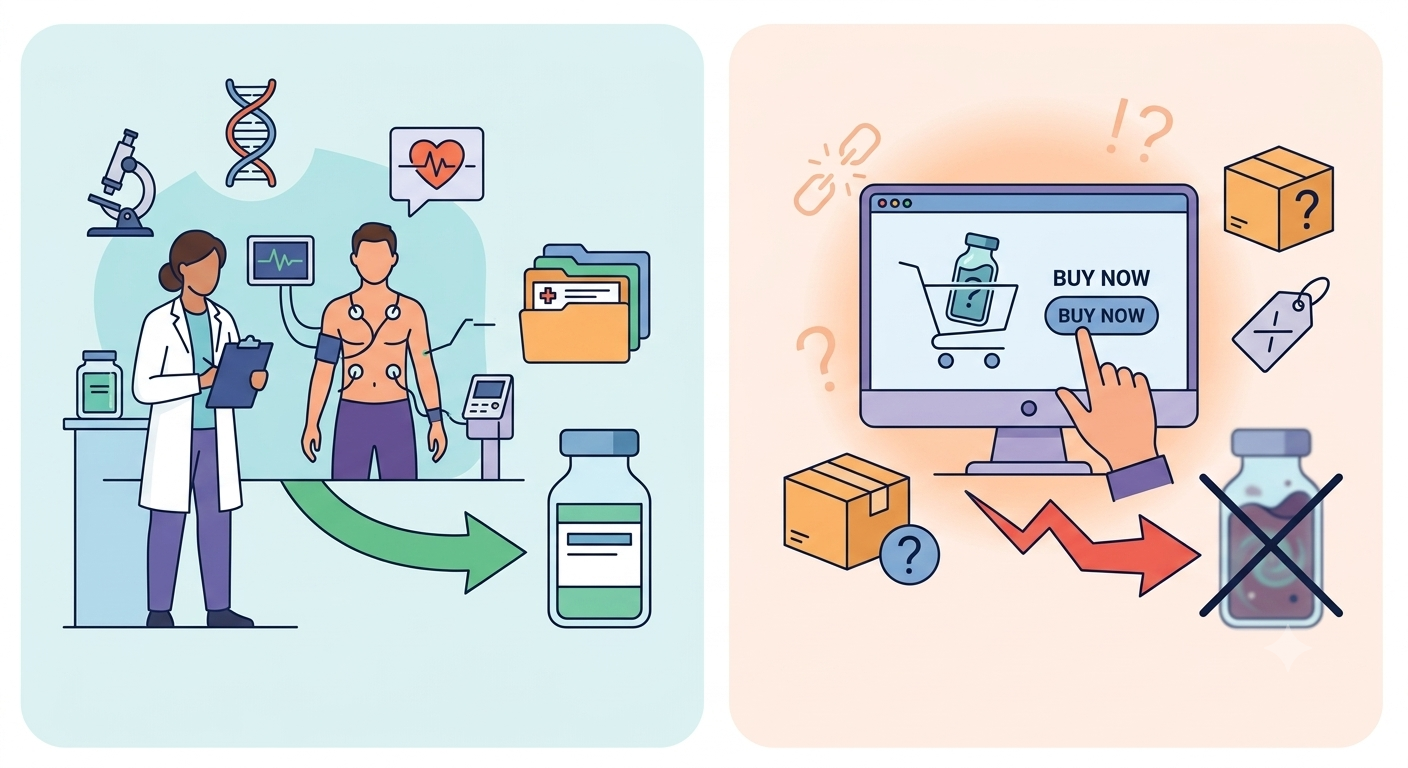
Retatrutide has gained major attention as a potential new treatment for obesity and related health problems. Early and later clinical research has shown significant weight-loss results, which has increased public interest. However, that interest has also created a growing online market for products that claim to contain retatrutide. This creates an important safety concern. Retatrutide remains an investigational medicine and is not currently approved for public use by the FDA. Therefore, products sold online outside authorized clinical research cannot be treated as approved medicines.
What Is Retatrutide?
Retatrutide is an investigational medicine being developed by Eli Lilly. Unlike medicines that act on one or two major hormone pathways, it activates three receptors. These include GIP, GLP-1, and glucagon receptors. Because of this action, researchers describe it as a triple agonist. The goal is to influence several processes linked to metabolism, appetite, blood sugar, and body weight. Clinical trials have produced encouraging results. However, promising research does not mean that a medicine is ready for general use.
Importantly, retatrutide is administered as a once-weekly injection in clinical studies. Researchers continue to study its benefits, risks, appropriate dosing, and possible uses. Therefore, consumers should separate scientific progress from online marketing claims. A product appearing on a website does not mean that the product has passed regulatory review.
Why Is Retatrutide Getting So Much Attention?
Weight management has become a major area of medical research. As a result, new medicines that produce substantial weight loss attract strong public interest. Recent Phase 3 results have added to the excitement surrounding retatrutide. In the TRIUMPH-1 trial, participants receiving the highest studied dose lost an average of 28.3% of their body weight after 80 weeks, according to Lilly’s May 2026 announcement. Some participants achieved weight loss of 30% or more.
Additional Phase 3 results have also shown meaningful changes in people with obesity and type 2 diabetes. In TRIUMPH-2, participants receiving the highest studied dose lost an average of up to 20.8% of their body weight at 80 weeks. TRIUMPH-3 also reported substantial weight reduction among adults with severe obesity and established cardiovascular disease. These findings help explain the growing interest. Nevertheless, trial results should not be confused with a guarantee for every individual.
Retatrutide Is Still an Investigational Drug
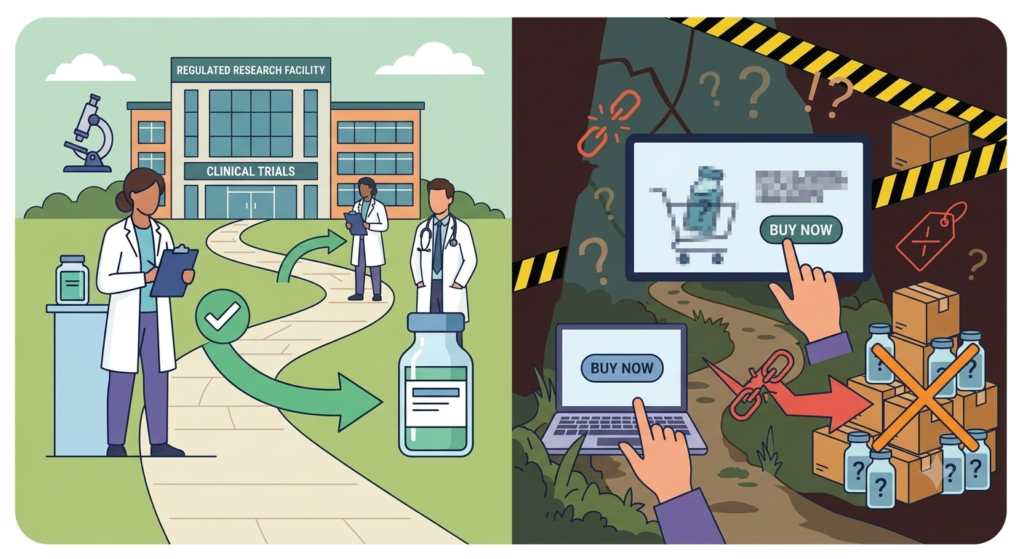
Retatrutide has not yet received FDA approval. That distinction is critical for anyone considering an online purchase. An investigational drug is still being evaluated. Researchers must establish that its benefits outweigh its risks. Regulatory authorities then review evidence from clinical studies before deciding whether the medicine can be approved.
As of July 2026, Lilly states that retatrutide is not approved by the FDA or any other regulatory agency. The company also says that it is legally available only through its clinical trials. The FDA explains that people generally access investigational medicines through clinical trials or, in certain situations, an authorized expanded-access program. Consequently, an online seller cannot make an investigational product safe simply by placing a label on a vial or package.
The Problem With Retatrutide Sold Online
Searching for retatrutide online can produce websites offering products described as research compounds, peptides, or non-human-use products. Some sellers may provide dosing instructions or make strong weight-loss claims. However, a website description does not prove what is inside the package. The FDA has specifically warned about unapproved products marketed as retatrutide. The agency says these products may contain unknown ingredients, harmful contaminants, impurities, too much active ingredient, too little active ingredient, or an entirely different ingredient.
First, the actual strength may not match the label. Second, the product may have been produced under conditions that do not provide appropriate quality controls. Third, storage or shipping conditions may affect the product. Finally, consumers may not know whether the substance has been handled correctly from production to delivery. Therefore, a low price or attractive website should never be used as proof of quality.
Why “Research Use Only” Does Not Make It Safe
One common marketing approach involves labeling products as “for research purposes” or “not for human consumption.” That wording does not make a product suitable for self-treatment. The FDA has warned companies that sold unapproved products containing retatrutide and other weight-loss compounds while using research-related labels. In some cases, these products were also marketed directly to consumers with instructions for human dosing.
This distinction matters because research materials are not automatically equivalent to approved medicines. A laboratory product may not have the same manufacturing, testing, labeling, or quality standards required for an approved medication. Therefore, consumers should be cautious when a seller uses scientific language to create an impression of medical legitimacy.
Retatrutide Safety Requires More Than a Label
Clinical trials are designed to identify both benefits and possible adverse effects. Participants are monitored under controlled conditions. Researchers can record side effects, laboratory results, changes in health, and other important outcomes. That process is very different from purchasing an unknown injectable product from an internet seller. Reported clinical-trial findings have shown gastrointestinal adverse events among participants, particularly during dose escalation. The exact safety profile continues to be evaluated across different populations and doses.
This does not mean that everyone taking an investigational medicine will experience the same effects. Instead, it shows why medical supervision and controlled research are important. Using an unapproved version can introduce another layer of uncertainty because the user may not know whether the product contains the claimed substance at the stated concentration.
What Online Buyers Should Check
Retatrutide should not be treated like an ordinary supplement purchased from a general online marketplace. When purchasing any prescription or medical product online, consumers should verify that the seller is operating legally and that the medicine is approved for its intended use. The FDA warns that unsafe online pharmacies may sell counterfeit, unapproved, or otherwise unsafe medicines.
For approved prescription medicines, legitimate online pharmacies generally require a prescription and provide appropriate pharmacy information. The FDA also recommends checking whether an online pharmacy is licensed and whether it provides access to a licensed pharmacist. However, retatrutide presents a special issue because it is not currently an FDA-approved medicine. Therefore, consumers should not assume that an online seller offering it is providing a legitimate prescription product.
Research Results Do Not Equal Approval
It is easy to assume that a medicine with strong clinical results must already be available. Yet drug development does not work that way. Researchers first study a compound in controlled trials. Later-stage studies can provide larger amounts of information about effectiveness and safety. Regulatory authorities then review the evidence.
Retatrutide has now generated substantial Phase 3 data. Lilly announced in July 2026 that it plans to submit a Biologics License Application to the FDA in the first quarter of 2027. That planned submission is an important development. Still, a planned application is not the same as an FDA approval. The regulatory process must be completed before the medicine can be marketed as an approved treatment.
What About Retatrutide for Weight Loss?
Interest in retatrutide weight loss comes largely from its results in clinical research. The Phase 3 TRIUMPH program is studying retatrutide in people with obesity or overweight and related health conditions. Studies have examined areas such as type 2 diabetes, knee osteoarthritis, obstructive sleep apnea, and cardiovascular disease.
In one Phase 3 study, the highest studied dose produced an average weight loss of 28.3% after 80 weeks. Another study involving obesity and knee osteoarthritis reported an average weight reduction of 28.7% at 68 weeks at the highest studied dose.
These numbers are promising. However, individual outcomes can vary widely. Trial participants also receive structured medical care, monitoring, and study-specific treatment plans. For that reason, online claims promising identical results should be viewed carefully.
Why Medical Guidance Matters
Weight management is not simply a matter of choosing the strongest medicine. A person’s medical history, current medicines, blood sugar levels, cardiovascular health, eating habits, and other factors can affect treatment decisions. A healthcare professional can also determine whether an approved treatment is appropriate. Moreover, weight-loss medicines are not suitable for everyone. Some people may have medical conditions or take medicines that require additional consideration.
Therefore, anyone interested in new obesity treatments should discuss options with a qualified healthcare professional rather than relying on online seller instructions. This approach also allows patients to consider approved alternatives that have established prescribing and safety information.
How to Avoid Risky Online Products
Consumers should be especially cautious when a website makes dramatic promises, sells injectable medicines without appropriate medical oversight, or avoids clear information about its legal status. The FDA advises consumers to avoid unsafe online pharmacies that offer prescription medicines without proper safeguards. It also warns that unapproved medicines can have unknown quality, safety, and effectiveness.
In addition, buyers should be wary of websites that pressure them to act quickly. Claims about guaranteed weight loss, secret formulations, or unusually cheap prices can also be warning signs. A professional-looking website is not enough. A convincing label is not enough either. The key question is whether the product has passed the required regulatory and quality checks.
The Future of Retatrutide
The future of retatrutide remains closely tied to ongoing research and regulatory review. The available Phase 3 findings have increased confidence that the compound may have an important role in future obesity and metabolic care. Lilly is continuing to study it across several conditions and plans to pursue regulatory submission.
At the same time, researchers must continue evaluating long-term safety and effectiveness. Regulatory authorities will also need to assess the complete evidence before making an approval decision. For consumers, patience is important. Buying an unapproved version from an unknown source does not provide the same safeguards as participating in a regulated clinical trial or using an approved medicine.
Make Safety the First Priority
The growing interest in new weight-loss medicines is understandable. However, retatrutide should not be purchased from online sellers simply because it appears to offer a promising shortcut. Clinical research has produced encouraging results, but the medicine remains investigational. The FDA has also warned about unapproved retatrutide products marketed online.
As research continues, consumers can make safer decisions by checking the regulatory status of medicines, avoiding unapproved injectable products, and speaking with qualified healthcare professionals. Strong clinical results are an important step, but proper approval, manufacturing standards, medical supervision, and reliable safety data matter just as much.